This Post Contents
8th pay commission PDF jcm PDF download(8th pay commission nc-jcm memorandum)-The National Council Joint Consultative Machinery (NC-JCM) drafting committee has officially outlined its memorandum for the 8th Pay Commission, presenting 21 major demands that include a proposed minimum basic pay of ₹69,000 and a fitment factor of 3.833. Please note that while many users are searching for the “8th Pay Commission NC-JCM memorandum PDF download,” the provided sources do not contain a direct link to download the official PDF file. However, the exact details of these 21 demands and the proposed pay structure have been prominently featured and published in the internet.
Comprehensive Guide to the 8th Pay Commission: 21 NC JCM Demands, Restructured Pay Matrix, and Guide
The anticipation surrounding the upcoming 8th Pay Commission has officially gained significant momentum for Central Government employees and pensioners. Recently, the drafting committee of the National Council Joint Consultative Machinery (NC JCM)—a key representative body for government staff—has actively placed its comprehensive demands before the government. If you are looking for the latest updates, proposed salary structures, or the official document, this detailed guide covers everything you need to know about the sweeping changes proposed.
The NC JCM drafting committee has meticulously prepared a list of 21 major demands aimed at improving the financial well-being, work-life balance, and retirement security of government employees. Furthermore, a massive structural change has been proposed, recommending the reduction of the existing 18 pay levels down to just 7 streamlined levels. Below, we will dive deep into each of these transformative proposals.
Major Highlights: Fitment Factor and Minimum Salary Proposals
One of the most critical aspects of any Pay Commission is the calculation used to revise salaries. The drafting committee has made highly ambitious proposals regarding the minimum pay and the fitment factor.
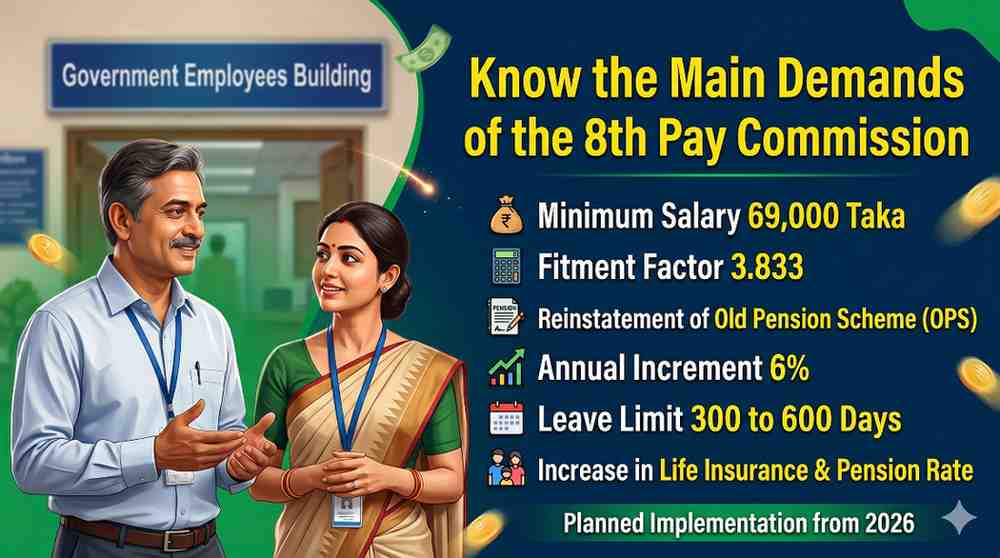
- Implementation Date: The committee demands that all benefits and structural changes of the 8th Pay Commission should be effectively implemented starting from January 2026.
- Minimum Basic Pay: There is a strong demand to increase the minimum basic pay to ₹69,000. This proposed figure was calculated by considering a family size of five units, aligning with a recent expansion of the family unit definition by the Ministry of Defence.
- Fitment Factor: To arrive at the new proposed salaries, a fitment factor of 3.833 has been demanded. Crucially, this multiplier is proposed to be applicable uniformly to both existing employees and pensioners.
- Annual Increments: In a bid to counter inflation more effectively, the committee has proposed doubling the annual increment rate. The demand asks for the annual increment to be set at 6% of the basic pay, a significant jump from the current 3% rate.
The 21 Key Demands by the NC JCM Drafting Committee
The draft prepared by the NC JCM drafting committee is extensive and covers almost every facet of government service, from immediate compensation to long-term pension benefits. Here is a detailed breakdown of the 21 vital points submitted for the 8th Pay Commission:
1. Promotions and Career Advancement
Stagnation in career progression has been a long-standing grievance. To address this, the committee demands that the Modified Assured Career Progression (MACP) scheme be upgraded to provide a minimum of five time-scale promotions instead of the current three. Furthermore, these five financial upgradations should be fully completed within 30 years of an employee’s service.
2. Pension, Retirement, and Post-Service Benefits
Retirement security forms a massive chunk of the NC JCM demands. The most prominent demand is the complete restoration of the Old Pension Scheme (OPS) for all employees who joined service after January 1, 2004. Additionally, the committee demands that the standard pension should be fixed at 67% of the employee’s last drawn pay. In unfortunate cases requiring family pension, the payout rate should be increased from the existing 30% to a more substantial 50%. The committee also requested the restoration of commuted pension after 11 years, which is a significant reduction from the current 15-year waiting period. Lastly, the highly debated One Rank One Pension (OROP) scheme should also be extended to Civilian employees.
3. Compensation, Insurance, and Compassionate Appointments
Risk and safety are heavily prioritized in the new draft. If an employee tragically loses their life while on duty due to an accident, the government should provide ₹1 Crore as compensation to the family. Alongside this, the committee demands a 100% guarantee for compassionate appointments in the event of such fatal mishaps or accidents. For general life coverage, Group Insurance must be significantly enhanced: ₹1 Crore coverage for Group C employees and ₹1.5 Crore for Group B employees.
4. Modernizing Leave Policies and Work-Life Balance
Government leave policies are slated for a massive modern overhaul if these demands are met. The maximum limit for the accumulation of earned leave should be doubled from 300 days to 600 days. The Earned Leave (EL) encashment permitted on Leave Travel Concession (LTC) is proposed to increase from 10 days to 20 days.
For parents, the demands are highly progressive. Fathers should be granted 45 days of Paternity Leave to support their partners. Maternity leave is proposed to be extended to 240 days, and the previous restriction limiting this benefit to only two children should be completely abolished. Moreover, a new category of leave called “Parents Care Leave” has been introduced, requesting 60 days of leave during an employee’s entire service period specifically for taking care of aging parents.
5. Allowances, Bonus, and Gratuity Revisions
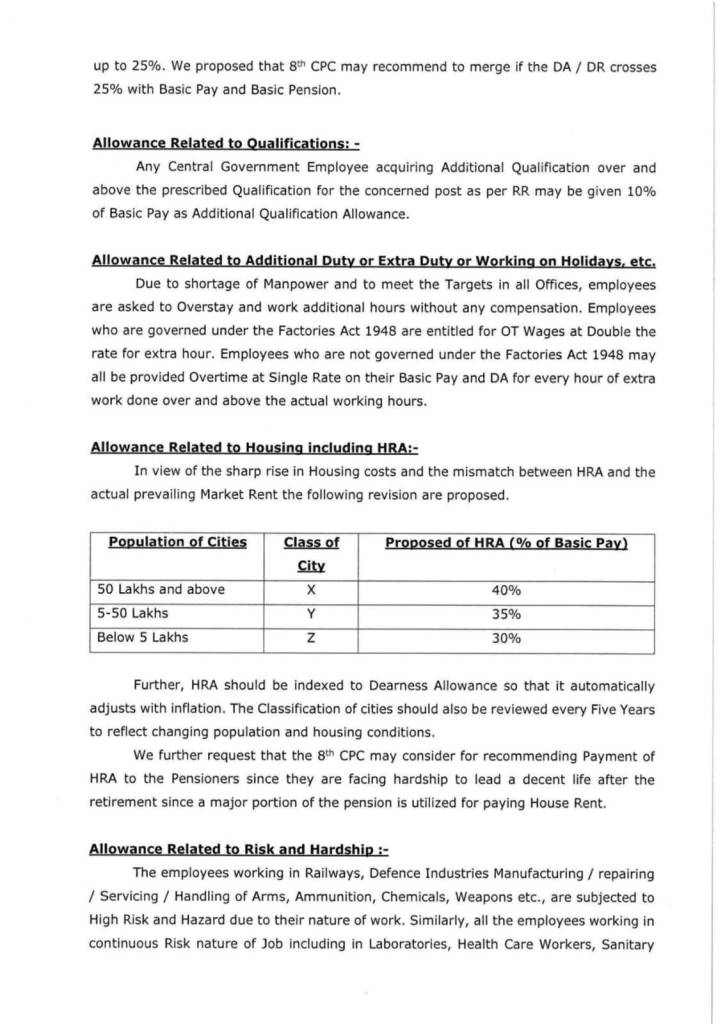
The committee demands that gratuity payments should equal one month’s wages for every year of service, and importantly, the existing maximum ceiling limit of 33 years should be completely removed. Regarding annual bonuses, there should be a guaranteed minimum bonus equivalent to 30 days, calculated on the actual Basic Pay along with Dearness Allowance (DA). House Rent Allowance (HRA) is proposed to be set at 40% for X category cities, 35% for Y category cities, and 30% for Z category cities, and this HRA must be directly linked to DA increments. Finally, there is a transitional demand regarding provident funds: employees should be shifted from GPF to NPS and UPS until the Old Pension Scheme is officially restored.
Massive Restructuring: 18 Pay Levels Reduced to 7
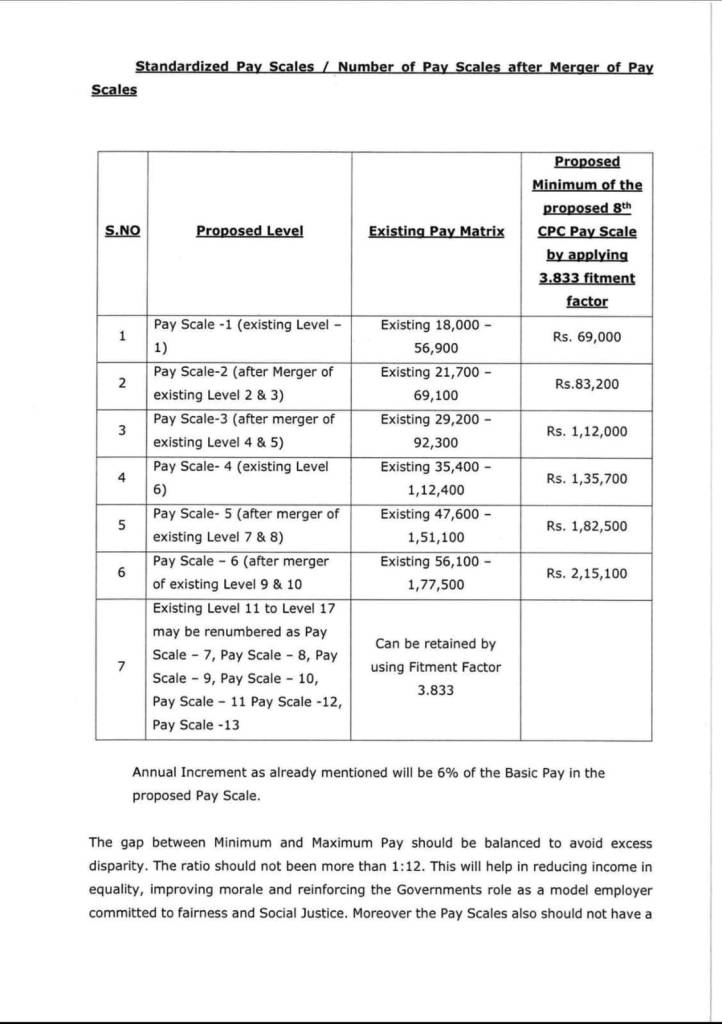
One of the most drastic structural changes proposed for the 8th Pay Commission is the consolidation of the Pay Matrix. Currently, under the 7th Pay Commission, there are 18 distinct Pay Levels. The NC JCM draft committee has proposed merging several brackets to reduce the total number of Pay Levels to just seven.
Below is a detailed table illustrating how the existing pay levels are proposed to be merged, along with the expected jump in minimum basic pay by applying the 3.833 fitment factor:
| Proposed New Level | Existing 7th CPC Levels Merged | Existing Minimum Pay Range (₹) | Proposed New Minimum Pay (₹) |
|---|---|---|---|
| Level 1 | Level 1 | 18,000 | 69,000 |
| Level 2 | Levels 2 & 3 | 21,700 to 69,100 | 83,200 |
| Level 3 | Levels 4 & 5 | 29,200 to 92,300 | 1,11,000 |
| Level 4 | Level 6 | 35,400 to 1,12,400 | 1,35,700 |
| Level 5 | Levels 7 & 8 | 47,600 to 1,51,100 | 1,82,500 |
| Level 6 | Levels 9 & 10 | 5,600 to 1,77,500 | 2,15,000 |
| Level 7 | Levels 11 to 17 | Varies | Calculated with 3.833 Fitment Factor |
Note: As per the draft committee proposal detailed in recent Economic Times publications, the fitment factor of 3.833 is proposed uniformly across these restructured levels.
Download Official 8th Pay Commission JCM Document
You can view and download the official comprehensive list of demands submitted by the NC JCM committee here.
Frequently Asked Questions (FAQs)
1. What is the proposed minimum basic pay in the 8th Pay Commission?
The NC JCM drafting committee has proposed a minimum basic pay of ₹69,000, calculating the requirement based on a family unit of five members.
2. What is the demanded fitment factor?
The committee has demanded a universal fitment factor of 3.833, which will be applicable to both current working employees as well as pensioners.
3. Will the 8th Pay Commission reduce the number of Pay Levels?
Yes, a major proposal in the draft is to reduce the existing 18 pay levels down to just 7 pay levels by merging several existing bands together.
4. Are there any changes to maternity and paternity leaves?
Absolutely. The draft demands 45 days of paternity leave for fathers, and an extension of maternity leave to 240 days with the removal of the two-child restriction limit.
5. When is the 8th Pay Commission expected to be implemented?
According to the demands submitted by the drafting committee, all benefits and structural adjustments should be officially implemented starting from January 2026.
8th pay commission PDF jcm PDF download
8th pay commission nc-jcm memorandum